
Preface
In his Poetics Aristotle notes that a drama consists of three movements (a beginning, a middle, and an end), resembling a triangle; whereas, in Ars Poetica, Horace expands this dramatic structure by declaring: “Let a play which would be inquired after, and though seen, represented anew, be neither shorter nor longer than the fifth act.” This five-act structure is common in the monomyth of the hero’s journey, as well as throughout Shakespeare’s plays. In telling the story of King David I follow the same dramatic arc of the five-act play: Act 1, consisting of exposition (which introduces the main characters and initial situation); Act 2, rising action (the protagonist pursues his goals, facing challenges and obstacles); Act 3, climax (the protagonist confronts his greatest challenge); Act 4, conclusion (the implications of the climax are revealed); and Act 5, denouement (the story’s end). In The Story of King David I frame this five-act structure with a Prologue and an Epilogue.
Prologue
In King David, the Real Life of the Man Who Ruled Israel, Jonathan Kirsch observes:
“At the heart of the Book of Samuel, where the story of David is first told, we find a work of genius that anticipates the romantic lyricism and tragic grandeur of Shakespeare, the political wile of Machiavelli, and the modern psychological insight of Freud. And, just as much as Shakespeare or Machiavelli or Freud, the frank depiction of David in the pages of the Bible has defined what it means to be a human being: King David is ‘a symbol of the complexity and ambiguity of human experience itself.’”
No two-dimensional pious character, David “played exquisitely, he fought heroically, he loved titanically,” as historian Abram Leon Sachar writes, “withal he was a profoundly simple being, cheerful, despondent, selfish, generous, sinning one moment, repenting the next, the most human character of the Bible.” Like everyone else, from Samuel to Saul to Jonathan—to God himself—when we encounter David we are charmed by him, and we fall under his spell. As a work of literature, the David story is the most complex and subtle narrative in scripture, and it is among the greatest stories in all of world literature, standing shoulder to shoulder with such epic works as Homer’s The Iliad and The Odyssey, Virgil’s Aeneid, and Thomas Mallory’s Le Morte d’Arthur.
But as with Achilles, Odysseus, Aeneas, and King Arthur, we might reasonably ask: Did King David actually exist, as he is portrayed in 1 & 2 Samuel? Did he really slay a giant, lead heroic warriors in battle, charm countless women, write seventy-three of the 150 psalms, forge a loose confederation of twelve tribes into a united monarchy, and elevate it to a position of world power? Or is the story of King David, with its memorable cast of characters—Samuel, Saul, the Witch of Endor, Goliath, Bathsheba, Solomon, Jonathan, and David’s “mighty men”—more akin to King Arthur and Camelot, with its cast of characters—Guinevere, Lancelot, Galahad, Merlin, and the Knights of the Round Table? Is the story of King David history as we understand it in 21st century modern terms, or is it a poetic reworking of traditional tales to form a national self-identity?
Prior to 1993, the only archaeological evidence to support David as a real, historical character was the Mesha stele, discovered in 1868 in Dhiban, Jordan. It dates from around 840 BCE and it includes a reference to the “kingdom of Israel” and “YHWH.” A reconstructed portion of line thirty-one may also refer to the “house of David,” but the reconstruction is purely hypothetical. Any doubt was erased in 1993, however, with the discovery of the Tel Dan stele, a broken piece of basalt that clearly mentions the “house of David,” proof of David’s historical existence, and suggesting a Davidic monarchy with something akin to the power and reach that we read about in scripture.
Here’s the story. The stele was part of an ancient wall at Tel Dan in northern Israel and was discovered by Gila Cook, a member of Avraham Biran’s archaeological team at Tel Dan. She discovered fragment A of the Tel Dan stele in July 1993 and she later discovered fragments B1 and B2 in June 1994. They are part of an inscription telling of a conflict between the king of Aram (modern-day Syria), probably Hazael (c. 842-796 BCE), and two Israelite kings, probably Jehoram (c. 849-842 BCE), king of Israel/Samaria, the son of Ahab and Jezebel, and Ahaziah (c. 842 BCE), king of the Judah, the son of Jehoram and Athaliah, of the house of David.
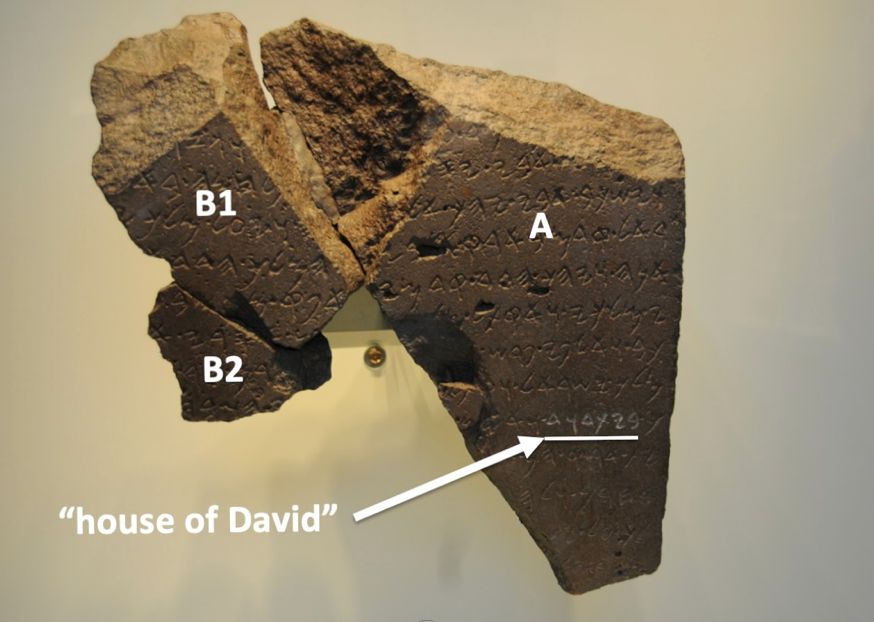
Tel Dan Stele
Israel Museum, Jersalem.
Photography by Ana Maria Vargas
So, based upon the evidence of the Tel Dan Stele, David was a real person who existed sometime around the ninth century BCE, but everything else we know about David comes solely from scripture. So we must ask again: “Is the story of King David history (as we understand history in our day), or is it a poetic reworking of traditional tales to form a national self-identity?” There is considerable evidence to suggest that, although many of the stories about David may have emerged shortly after his reign (c.1010-970 BCE), the story as we know it from 1 & 2 Samuel was probably fashioned during the reforms of King Josiah (c. 640-609 BCE) and revised and polished shortly after the Babylonian exile (c. 586-539 BCE).
But that does not diminish our story. The tale of David follows the broad strokes of actual historical events, as we understand them, but 1 & 2 Samuel does not glorify the past to illuminate the present in a pleasing, idealistic light, as much national mythology does. In the David story there is simply too much dirt, too much blood, too many betrayals, and far too many skeletons in David’s closet. David is not the pious, wise, and magnanimous founder of a dynasty that we might expect; rather, the story of David is as rough and gritty as sandpaper and as morally questionable as a salacious headline in the National Enquirer. In fact, 1 & 2 Chronicles, composed around 350-300 BCE, gives us a bowdlerized version of David’s story, narratively photo-shopped, cropped, and airbrushed to remove David’s blemishes, flaws, and dark shadows. Chronicles gives a far more fitting story for pious ears and delicate sensibilities.
The story of King David is not history as we understand it today, but history reimagined, as Shakespeare re-imagines history in Henry IV, giving us Prince Hal, Falstaff, and Mistress Quickly. And like Shakespeare, our final author/editor of 1 & 2 Samuel brings to bear all the gifts of a world-class writer: he invents the inner life of his characters; he crafts revealing dialogue; he weaves actions and characters to create suspense and intrigue; he misleads, only to reveal; he displays noble behavior, cloaking malicious motive; and he defines his characters through allusion, metaphor, and symbol. Our author doesn’t give us history to recount literal events; rather, he reimagines history that we might understand it.